
This guide explains how boxing supports weight management, how many calories a workout may burn, and how boxing compares with HIIT. You will also learn how to build a beginner-friendly weekly routine and measure progress without expecting overnight results.
Does Boxing Help Lose Weight?

Does boxing help lose weight? Yes, boxing can support weight loss by combining cardiovascular exercise with strength-building movements. The results depend on workout intensity, consistency, nutrition, and overall activity levels.
These activities increase energy expenditure. When you consistently use more energy than you consume over time, your body can gradually lose weight. Boxing can help you work toward that balance, but no single workout guarantees fat loss.
Boxing may support weight management in several ways:
- Cardiovascular fitness: Repeated rounds of movement challenge your heart and lungs.
- Muscle engagement: Punching, moving, and maintaining a stable stance involve the shoulders, arms, legs, and core.
- Workout variety: Learning combinations and improving technique can make exercise more engaging.
- Training consistency: Enjoyable sessions may help you maintain a regular exercise routine.
Boxing does not selectively burn fat from your stomach, arms, or another specific area. Changes in body fat happen throughout the body, and where fat decreases first varies between individuals.
Does Boxing Help Lose Weight? Calories Burned Explained
Calorie expenditure is one reason people consider boxing for weight management. However, how many calories does boxing burn depends on several factors, including body weight, workout duration, exercise intensity, rest periods, and individual fitness.
A technically focused beginner class may involve frequent demonstrations and breaks. A conditioning session with continuous movement may demand more energy. As a result, two people attending the same class can burn different amounts of energy.
The following table provides broad illustrative estimates, not guaranteed calorie counts.
| Boxing workout | Approximate calories burned in 30 minutes |
|---|---|
| Light technique practice | 100–200 |
| Moderate boxing workout | 200–300 |
| Vigorous boxing or conditioning | 300–450 |
These ranges are general estimates. Actual expenditure may fall outside them, and fitness trackers can also be inaccurate. Use the figures to understand how workouts differ rather than treating them as exact measurements.
Your total weekly activity matters more than a single session. For example, three consistent workouts each week may contribute to your overall energy expenditure, especially when paired with everyday movement and sustainable eating habits.
Beginners should prioritize learning correct technique and building endurance before trying to maximize intensity. Longer or harder workouts are not automatically better if they leave you exhausted or make it difficult to train consistently.
Does Boxing Help Lose Weight More Than HIIT?
Boxing and high-intensity interval training (HIIT) can both support weight management. The right choice depends on your fitness level, preferences, recovery needs, and ability to maintain the routine.
HIIT alternates periods of intense activity with lower-intensity recovery. A boxing class may include a similar interval structure, particularly when rounds alternate with short breaks. However, boxing classes can also focus primarily on technique and controlled practice rather than continuous high-intensity exercise.
| Feature | Boxing | HIIT |
|---|---|---|
| Main activities | Punching drills, footwork, bag work, conditioning | Repeated high- and lower-intensity exercises |
| Skill development | Builds coordination and boxing technique | Depends on the exercises selected |
| Intensity | Varies by class and training round | Usually structured around planned intervals |
| Equipment | May include gloves and a heavy bag | May use body weight or exercise equipment |
| Beginner suitability | Can be adapted to different skill levels | Can be adapted, but exercise selection matters |
| Weight-loss support | Contributes to energy expenditure | Contributes to energy expenditure |
Neither option automatically produces greater weight loss. Total activity, nutrition, workout consistency, and recovery all influence results.
If you enjoy learning combinations and practicing a sport, boxing may be easier to stick with. If you prefer short, structured intervals, HIIT may suit you better. You can also combine different forms of exercise throughout the week rather than relying on one method alone.
For more information about training options, explore our adult boxing classes in Richmond Hill.
Does Boxing Help Lose Weight With Better Nutrition and Sleep?
Exercise is only one part of weight management. Your eating habits and recovery influence how well you can train and maintain a routine.
A sustainable approach focuses on regular, balanced meals rather than extreme calorie restriction. Include protein sources, vegetables and fruit, whole grains or other fiber-rich carbohydrates, and healthy fats according to your needs. These foods can help provide the nutrients and energy required for training.
You do not need to eliminate entire food groups or follow a restrictive diet to benefit from boxing. Consistently eating far too little can leave you feeling tired, interfere with recovery, and make regular workouts harder to maintain.
Hydration also matters, particularly during sessions that involve sustained movement or sweating. Drink water throughout the day and adjust your intake around exercise according to thirst, conditions, and workout demands.
Sleep supports recovery and helps you feel ready for your next session. Insufficient sleep can affect energy, appetite, and exercise performance. Aim for a consistent sleep schedule and allow enough recovery time between demanding workouts.
Keep these practical principles in mind:
- Eat balanced meals that provide enough energy for daily activities and exercise.
- Include protein regularly to support muscle repair.
- Drink water before, during, and after training as needed.
- Maintain a consistent sleep schedule.
- Avoid trying to compensate for eating by adding excessive exercise.
The goal is to build habits that you can sustain, not to make every meal or workout perfect.
Does Boxing Help Lose Weight With a Weekly Workout Plan?
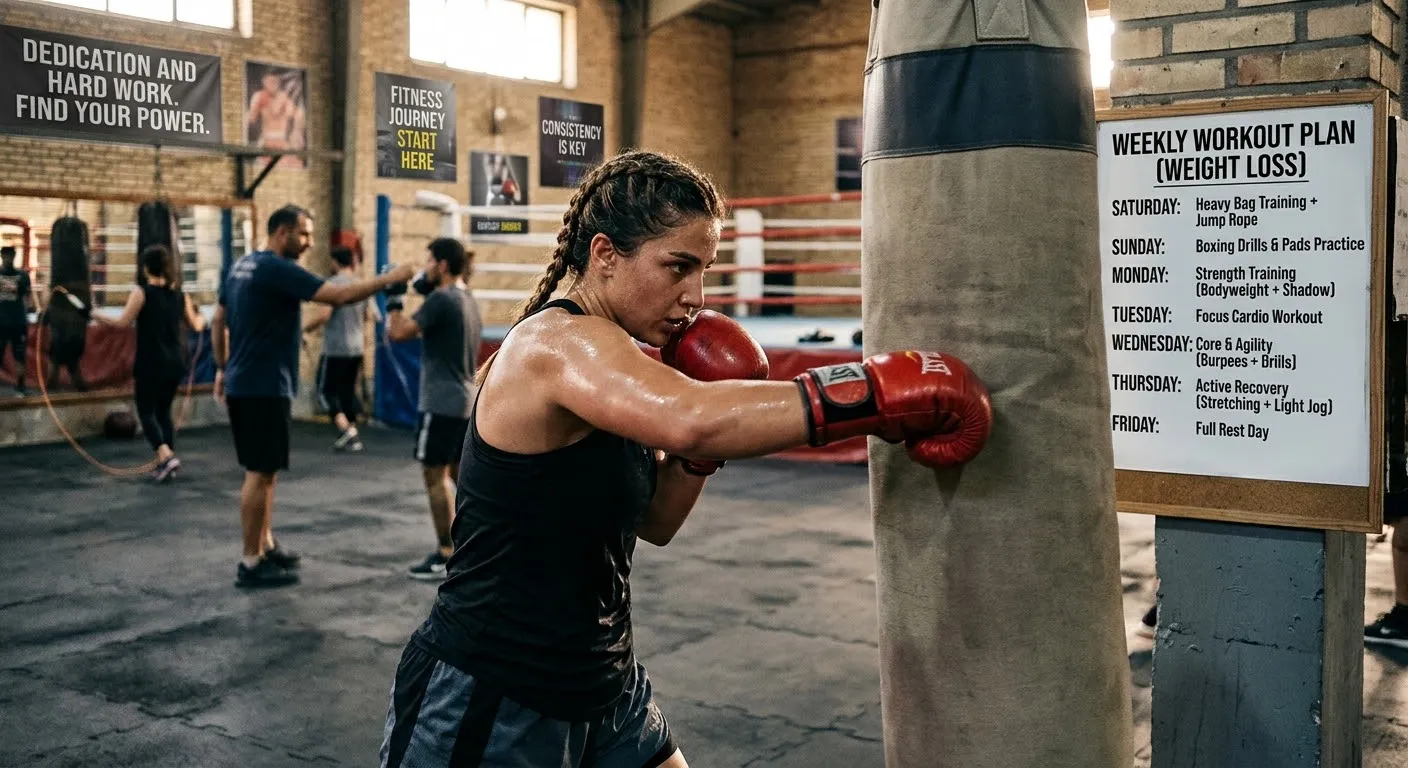
Beginners do not need to box every day to make progress. Starting with two or three sessions per week allows time to learn technique, build fitness, and recover between workouts.
Here is an example schedule you can adapt to your experience and overall activity level.
| Day | Activity | Main focus |
|---|---|---|
| Monday | Beginner boxing class | Technique and basic conditioning |
| Tuesday | Walking or light activity | Active recovery |
| Wednesday | Beginner boxing class | Footwork and combinations |
| Thursday | Rest or gentle mobility | Recovery |
| Friday | Boxing or full-body strength training | Fitness and strength |
| Saturday | Comfortable walk or recreational activity | General movement |
| Sunday | Rest | Recovery |
You can adjust the schedule to suit your availability. If three boxing sessions feel too demanding at first, begin with two and increase gradually as your fitness improves.
During a beginner class, your coach may introduce basic punches, stance, defensive movements, and controlled combinations. Follow the instructor’s guidance rather than trying to match the pace of experienced boxers.
To make your routine easier to maintain:
- Start at a manageable intensity. Focus on technique and controlled movement before increasing workout difficulty.
- Set a realistic schedule. Choose training days that fit your work, sleep, and other commitments.
- Increase activity gradually. Add time or intensity only when your body is recovering well.
- Track consistency. Record completed workouts instead of judging progress by one difficult session.
- Make recovery part of the plan. Rest days help you return to training with enough energy.
If you experience persistent pain, dizziness, or unusual shortness of breath, stop exercising and seek appropriate medical advice. Your plan should challenge you without ignoring your body’s signals.
Tracking Weight-Loss Results
When asking does boxing help lose weight, remember that results depend on more than the number displayed on a scale. Weight can fluctuate from day to day because of hydration, food intake, digestion, and other normal changes.
Look for trends over several weeks instead of judging progress after a single workout. If weighing yourself is useful for you, measure under similar conditions and compare averages over time.
You can also track other indicators of progress:
- Workout consistency: How often are you completing your planned sessions?
- Endurance: Can you maintain movement for longer before needing a break?
- Technique: Are your punches, footwork, and combinations becoming more controlled?
- Recovery: Do you feel ready for your next workout?
- Clothing fit and measurements: Are you noticing gradual changes over time?
Weight loss varies from person to person. Your starting point, nutrition, activity level, sleep, and other individual factors all play a role. Avoid setting expectations based on dramatic transformations or assuming that everyone will progress at the same speed.
If your weight is not changing, review your overall habits before simply adding more intense workouts. Consistency, appropriate nutrition, and recovery are more useful foundations than extreme exercise or restrictive eating.
Is Boxing Good for Beginners Who Want to Lose Weight?

Boxing can be a suitable exercise option for many beginners, even if they have limited fitness experience. A beginner-friendly class should introduce movements progressively, explain technique clearly, and allow participants to work at an appropriate pace.
You do not need to be in peak physical condition before starting. Your initial sessions may focus on stance, basic punches, footwork, and short rounds with rest between activities. Fitness and coordination can improve as you practice consistently.
You also do not need to begin with sparring. Many introductory classes focus on technique, bag work, and conditioning. Ask the coach what a trial session includes so you know what to expect.
Before starting, tell your coach about relevant injuries or physical limitations. If you have a medical condition that may affect exercise, consult a qualified healthcare professional about appropriate activity.
The most useful routine is one that fits your current ability and that you can continue over time. Choose a class where you feel comfortable learning, asking questions, and progressing gradually.
If you are asking does boxing help lose weight, consider whether boxing is an activity you enjoy enough to keep doing. Combine manageable training sessions with balanced nutrition, adequate sleep, and recovery rather than expecting one workout to deliver immediate results.
You do not have to be an experienced athlete to begin. Start with the basics, learn from a qualified coach, and build your routine at a pace that works for you.
Ready to get started? Book a Free Trial at Cheriki Boxing Academy and discover what a beginner boxing session is like.
Boxing for Weight Loss: Frequently Asked Questions
Can boxing help reduce belly fat?
Boxing increases physical activity and can support overall fat loss when combined with appropriate nutrition. However, no exercise can guarantee fat loss from a particular body area. Changes in belly fat vary between individuals.
How many times a week should beginners box for weight loss?
Two or three sessions per week can be a reasonable starting point for many beginners. Your ideal frequency depends on session intensity, recovery, other activities, and fitness level. Increase gradually rather than training hard every day from the beginning.
Is boxing better than running for weight loss?
Neither is universally better. Both can increase energy expenditure, and the amount depends on duration, intensity, and individual factors. Boxing may appeal to people who enjoy skill-based workouts, while running may suit those who prefer a simpler activity.
Do you need to change your diet if you start boxing?
You do not necessarily need a strict diet, but eating habits affect weight management. Balanced meals, appropriate portions, hydration, and consistent routines can help support training and longer-term goals.
How long does it take to notice results from boxing?
There is no fixed timeline. Some people notice improvements in coordination or stamina before seeing changes in body weight. Changes in body composition depend on multiple factors, so focus on consistent training and longer-term trends.
Final Thoughts: Is Boxing Worth Trying for Weight Loss?
Boxing can be a practical and engaging way to increase physical activity, improve cardiovascular fitness, develop coordination, and support weight management. Its benefits depend on how consistently you train and how your workouts fit into your overall lifestyle.

From First Class to the National Stage: The Cheriki Pathway
Every competitive boxer starts somewhere, and the journey toward becoming one of the Cheriki boxing champions begins with learning the fundamentals. For some athletes, that
Can You Start Boxing at 40? A Beginner’s Guide for Adults Over 30, 40 & 50
Many adults wonder whether it is too late to learn a new sport once they reach their thirties, forties or fifties. The question comes up

Boxing for Teens: Discipline, Confidence & Less Screen Time
Many parents notice that teenagers can struggle with focus, motivation and the constant pull of phones and screens. Structured physical activity can offer a practical